|
Dear Friend of Israel, Friend of FLAME:
For decades, major Western powers and Persian Gulf states based their foreign policies on trembling fear of Iran.
They believed if they squeezed Iran too hard on its nuclear weapon ambitions, its sprawling web of terrorist proxies and its outright declarations of hostility toward the U.S. and Israel, the Islamic Republic would lash out, wreaking regional instability at best and conflagration at worst.
Today, thanks to the courage and military superiority unleashed primarily by Israel, with major U.S. support, that fear and those threats have been vanquished. Israel has emerged as the sole Middle East superpower, and as such, its neighborhood . . . and the world . . . are safer.
Indeed, backed by an emboldened United States and a determined President Trump, Israel now has the chance to form unprecedented alliances with its neighbors and initiate a new era of Middle East peace. Over the coming months, Trump and Israel’s Prime Minister Netanyahu will likely focus efforts on guiding candidates like Saudi Arabia, Syria and Lebanon into the Abraham Accords.
Unfortunately, some legacy media continue efforts to discredit or diminish the Israel-U.S. victory over Iran and its proxies despite overwhelming evidence of its success.
Nevertheless, as the dust settles following October 7th’s savage attack on the Jewish state and the subsequent 21 months of Israel methodically eviscerating Iran’s Axis of Terror, two things have become clear.
First, the last 46 years of attempts to diplomatically bribe, pressure and appease Iran and its allies into peace (or even coexistence) failed completely. Second, increasingly, the only way to achieve peace with religious fanatics seems to be through military force.
The West and Iran’s neighbors always feared being dragged into a “forever” war. In 2015, for example, President Barack Obama argued that attacking Iran would lead to “Another Middle East war that could drag on for years.” Gulf Arab states have historically thought similarly. Indeed, during President Trump’s Persian Gulf tour last May, the leaders of Saudi Arabia, the UAE and Qatar raised concerns with the President that striking Iran could trigger retaliation against their own countries.
This fear of an apocalyptic, intractable conflict with Iran led to exhaustive, but non-productive diplomacy even as Iran steadily ramped up its global jihad, advanced its nuclear program and bolstered its terrorist proxies.
Israel’s definitive defeat of Iran and its proxies was achieved through military superiority. The Israeli Defense Forces (IDF) had already laid waste to Iran’s proxies—Hamas in Gaza, Hezbollah in Lebanon, and the Houthis in Yemen—eliminating nearly all their top leaders and destroying most of their terrorist infrastructure. But Israel’s crowning achievement was the war against Iran itself.
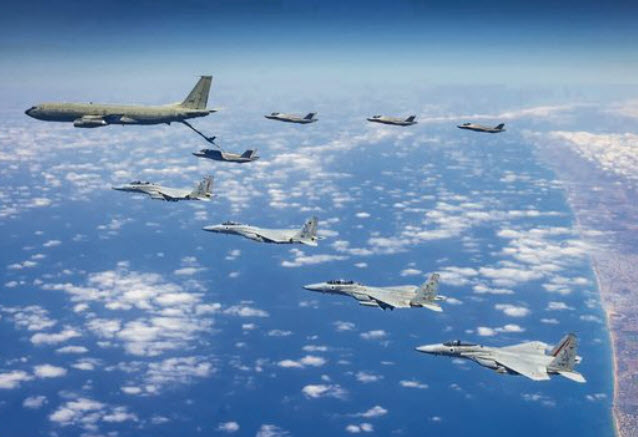
Astoundingly, in just one day, Israel killed 30 senior Iranian military commanders, including the head of the elite Iran Revolutionary Guard Corps (IRGC) and the chief-of-staff of Iran’s armed forces. In just three days, the Israeli Air Force (IAF) achieved air superiority over central Iran, flying over a thousand sorties over the Islamic Republic without losing a single fighter jet.
In an article in the Jerusalem Post, U.S. military veteran and expert John Spencer described Israel’s campaign against Iran as “transformational. It redefined what shock and awe can look like in the 21st century.” It was a “synchronized, multi-domain offensive that combined cyber, human intelligence, electronic warfare, airpower, special operations, and psychological operations.”
Indeed, Israel emerged from the conflict as the Middle East’s “strong horse”—its sole superpower. No other nation in the region—not Turkey, not Saudi Arabia, and certainly not Iran—has ever demonstrated such military prowess.
Ultimately, the fears that shaped Western and Arab policy proved unfounded. Iran turned out to be a paper tiger. It didn’t unleash a regional war, nor did its retaliation cause immense casualties. The U.S. suffered no losses and Israel’s loss of 29 civilians, while tragic, were far fewer than IDF generals predicted, since few Iranian missiles and drones managed to evade Israeli and American air defense systems.
Predictably, some mainstream media still cast aspersions on the U.S.-Israeli victory. Last week, for example, the Washington Post downplayed U.S. strikes on Iranian nuclear facilities as “less devastating than expected,” citing intercepted conversations among Iranian officials. Similarly, CNN reported that the head of the UN’s nuclear watchdog said Iran could start enriching uranium again “in a matter of months.” Truthfully, assessments by the CIA, the Pentagon and the IDF all conclude that Iran’s nuclear program was set back by years.
Such biased media reports seem motivated by a campaign of “resistance” against any achievements, no matter how noble or successful, by the current U.S. administration and Israel.
This historic episode provides a clear lesson: When diplomacy with religious fanatics fails, often only military options remain. Indeed, the U.S. and its allies relied on diplomacy for decades, believing Iran’s ayatollahs were rational and would settle for financial incentives, guarantees of security and acceptance by the international community.
Evidence proves that such diplomatic “carrots” fail to motivate Islamist extremists bent on destroying Israel, the U.S. and the rest of Western civilization. The determination by Iran to create a nuclear-powered, global Islamic caliphate was only stopped by military force.
Israel’s victory indisputably made the Middle East more secure and increases the chances of peace. When Israel and the U.S. attacked Iran, their goal was to make the Middle East safer—a goal that decades of fruitless diplomacy failed to achieve. Because of Israel’s and the U.S.’s great victory, Iran’s ability to threaten its neighbors is dramatically diminished.
President Trump and Prime Minister Netanyahu can now shift their focus to regional peace—such as first ending the Gaza war, then beginning a process of enticing more Arab nations, such as Saudi Arabia, Syria and Lebanon, into the Abraham Accords.
In short, it was indomitable strength in the face of jihadi obsession and obstinacy that led Israel and the U.S. to an historic victory in the Middle East. Thankfully, the priorities expressed by both superpowers indicate the result will not be conquest, but greater security and peace in both the region and the world.
Please make the point when speaking with family, friends, colleagues—or in letters to the editor—that evil does not negotiate. Fanatical enemies who answer to a god that demands murderous global conquest may sometimes only be defeated by a war well and bravely fought.
If you agree we need to spread this truth, please use your email browser to forward this Hotline issue to fellow lovers of Israel—and encourage them to join us by subscribing to the Hotline at no charge.
Best regards,
James Sinkinson, President
Facts and Logic About the Middle East (FLAME)
P.S. I’m sure you’d agree: If your enemy says they want to kill you and take your land, you’d be smart to believe them. If you try to make peace, but they refuse all your offers and continue to make murderous threats, it’s time to eliminate this enemy. Israel has faced exactly this danger with the Palestinians—yet continued to hope for peace . . . until Hamas’s October 7 massacre and kidnappings. Finally, Israel and many lovers of Israel are facing reality. They’ve concluded their futile dreams of peace must end. They must finally defeat their Palestinian enemies—starting with Hamas and other jihadi terrorists. I hope you’ll agree that we supporters of the Israel-U.S. relationship need to speak out. FLAME’s new hasbarah—explanatory message—“End of the Palestinian Lie”—describes how Israel and the West have for 77 years bought the myth that the Palestinians want peace. It details the many offers of land for peace Israel, the U.N. and the U.S. have made to give Palestinians their own state—all refused. Finally, it explains why Israel must adopt a bold new strategy—disarming, disabling and defeating Hamas and all other terror groups that attack Israeli civilians. Please review this convincing, fact-based editorial, which FLAME intends to publish to millions—in leading social media, as well as in the Washington Post, Wall Street Journal, New York Post, Chicago Tribune, Tampa Bay Times, Denver Post and Los Angeles Times. This piece will also be sent to all members of Congress, the President and Vice President. If you agree that this kind of public relations effort on Israel’s behalf is critical, I urge you to support us with a donation.
As of today, more than 28,000 Israel supporters receive the FLAME Hotline at no charge every week. If you’re not yet a subscriber, won’t you join us in receiving these timely updates, so you can more effectively tell the truth about Israel? Just go to free subscription.
|